

Turning Handwritten Timecards into Usable Data for Wage-and-Hour Cases
In This Article:
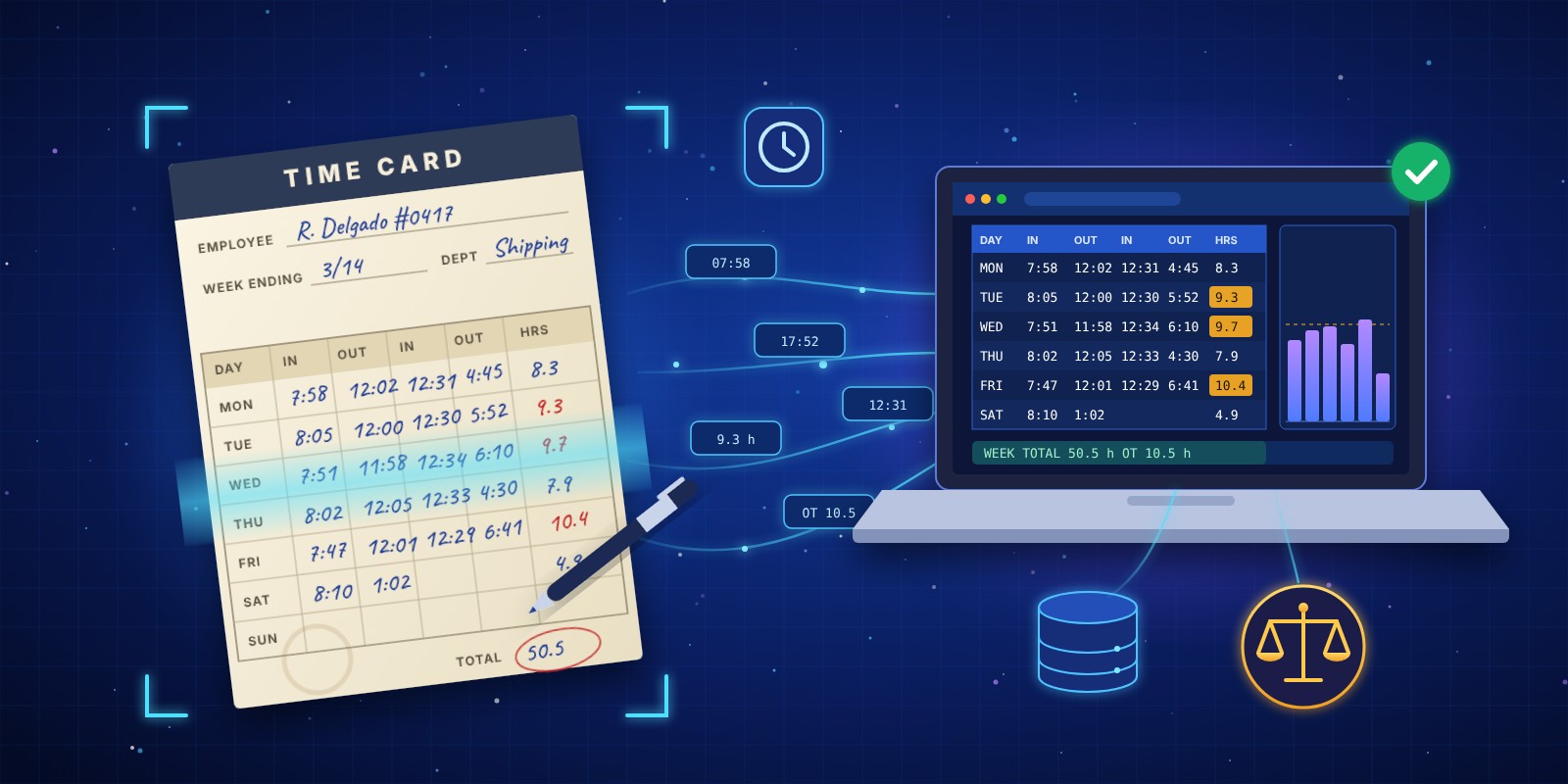
In wage-and-hour cases, the evidence often sits in boxes of handwritten timecards, timesheets and payroll reports. Before an expert can calculate unpaid overtime or missed breaks, every punch, shift and pay period has to become structured data.
That step is slow, detailed and easy to get wrong. Here is what makes timecard data difficult, what a defensible process looks like, and how two law firms handled it under deadline.
Why Timecard Data Is Hard to Work With
- Entries are handwritten, faded or crossed out, so automated tools misread them
- Formats change across departments, locations and years
- Volumes run into hundreds of thousands of records
- Hours worked must be checked against hours paid
- Meal and rest break details are often scattered across different documents
What Data Gets Captured
A typical project captures, for every employee and shift:
- Punch-in and punch-out times
- Regular and overtime hours
- Hourly rates and wage amounts
- Gross pay and pay period details
- Meal and rest break data
The output is normalized into spreadsheet-ready data that the expert can use for damages calculations.
What Makes Timecard Data Defensible
Clear Field Rules
Field definitions are agreed with the legal team and expert before entry starts, and tested on sample documents.
Responsiveness Review
Records are reviewed and tagged for responsiveness first, so data entry effort goes only to the documents that matter.
Anomaly Tagging
Altered hours, or hours that do not match pay records, are flagged for review instead of being silently corrected.
Multi-Level Quality Control
Separate quality checks and audits confirm accuracy before delivery.
Documented Methodology
A written record of the process helps the data withstand challenges to its validity and admissibility.
Two Recent Examples
Rest-Break Class Action for Two AmLaw 100 Firms
Two labor and employment firms needed to show whether employees took their rest breaks or worked off the clock. The evidence was in handwritten timesheets. Our team:
- Reviewed and tagged over 1.5 million pages for responsiveness
- Identified 570,000 employee time records
- Captured 24 fields per shift, 3.1 million data points in total
- Kept accuracy above 99% despite poor image quality and handwriting
- Delivered Phase 2 a week early, with a written declaration of the methodology
A Discovery Deadline with Four Weeks Left
An employment law firm’s original vendor could not deliver, with four weeks left before discovery closed. Our teams ran both phases in parallel and:
- Transcribed 150,000 lines of time records for about 200 employees across 20 departments
- Captured 1.65 million data points in 4 weeks at over 99.5% accuracy
- Delivered 3 days before the deadline and 22% under budget
Why Choose 247Digitize for Timecard Data Entry?
247Digitize provides timecard data entry services for labor and employment law firms and consulting experts across the United States. Our teams specialize in handwritten records that automated tools struggle with.
We work in an ISO 27001-certified environment, sign protective orders where required, and scale teams quickly to meet discovery deadlines.
Conclusion
In wage-and-hour cases, the quality of the data shapes the strength of the analysis. A clear process, careful quality control and documented methodology turn boxes of timecards into evidence your expert can rely on.
To discuss your next wage-and-hour matter, contact 247Digitize for a free quote.

