

How Law Firms Cut Discovery Costs with Custom Document Indexing
In This Article:
Document review is often the most expensive part of discovery. The cost climbs fastest when the collection is a large archive of old paper records, scanned in bulk with no structure and poor legibility.
In these cases, keyword searches miss too much, and teams fall back on linear review: reading every page in order. Custom document indexing offers a better route. Here is how it works, and what it saved one law firm.
Why Legacy Collections Drive Up Review Costs
Historical records rarely arrive ready for review. Typical problems include:
- Scans with no document boundaries, so one file holds hundreds of separate documents
- Faded, handwritten or poor-quality pages that OCR cannot read reliably
- No metadata, so documents cannot be filtered by date, author or type
- Millions of pages, with only a fraction relevant to the case
When search tools cannot find what matters, every page needs human eyes. That is where budgets and deadlines come under pressure.
How Custom Indexing Changes the Review
Unitize the Collection First
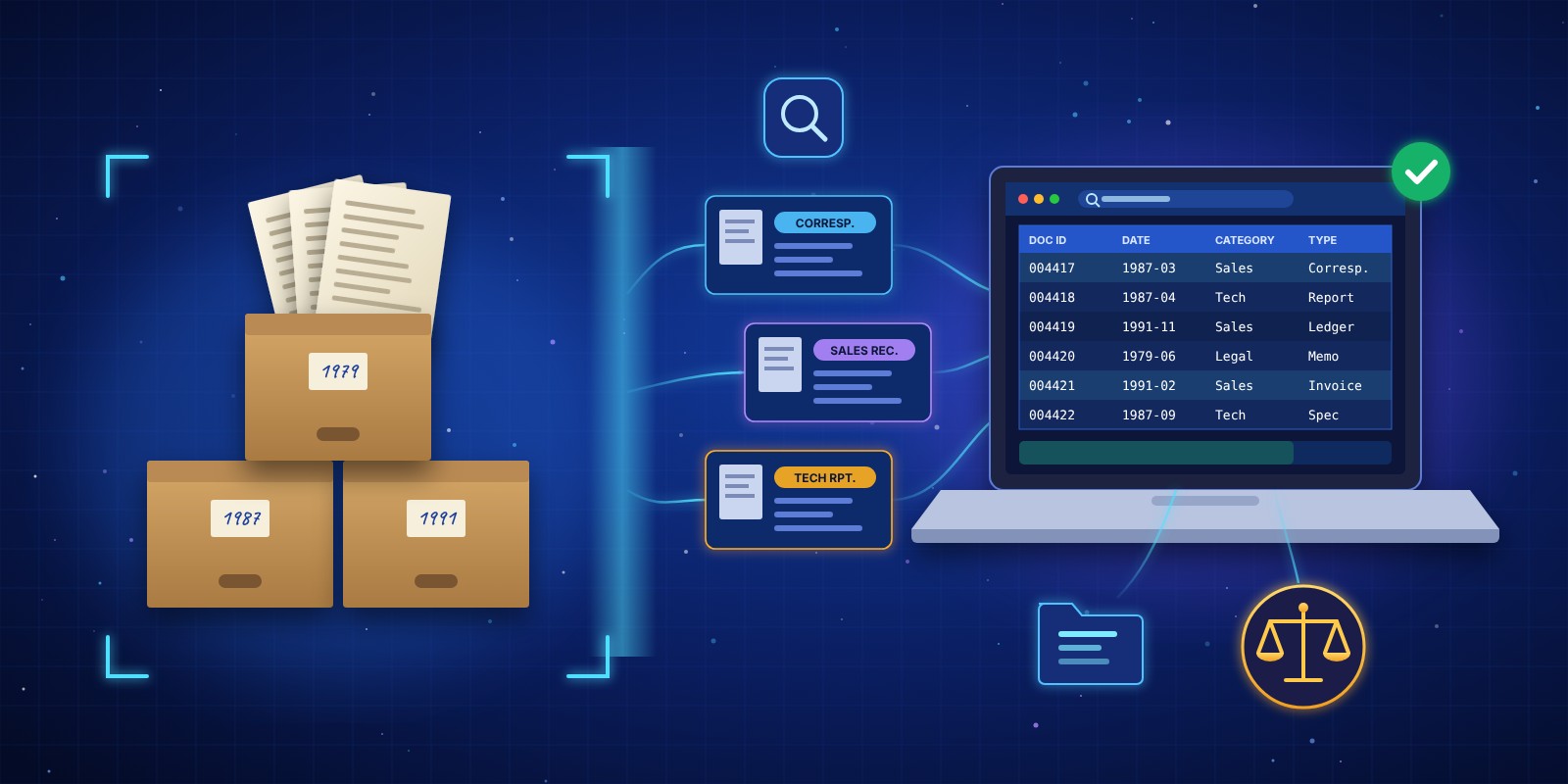
Unitization, also called logical document determination (LDD), marks where each document starts and ends. Without it, nothing downstream works properly.
Categorize the Records
A first pass sorts unitized documents into categories that matter to the case, such as sales records, correspondence or technical reports.
Code the Fields That Matter
Reviewers then capture custom fields for each document, such as date, author, recipient, document type or product. This builds on standard bibliographic coding, extended to fit the issues in the case.
Target the Review
With a coded index, the legal team searches and filters the collection instead of reading it end to end. Attorneys spend their time on the documents that matter, which is where managed document review delivers the most value.
Case in Point: 2.7 Million Pages of Historical Records
A law firm handling class action suits for large corporations faced 2.7 million pages of historical sales data and correspondence. The records had to be reviewed for responsiveness and issue tagging, but they were poorly organized and barely legible.
247Digitize designed a two-phase approach: first-level categorization of the unitized records, then custom coding to support targeted searches and avoid costly linear review.
- 2,727,734 pages unitized in 4 weeks, 2 weeks ahead of schedule
- 675,608 documents coded across 8 record categories, with up to 10 custom fields each
- 5.5 million fields coded in total
- Coding output rose from 40,000 to 55,000 documents a week
- Coding finished 5 weeks early
- An estimated $1.1 million saved over 6 months
You can read the full case study for more detail.
When Custom Indexing Makes Sense
Custom indexing pays off most when:
- The collection is large, old or mostly paper-based
- Image quality is too poor for reliable OCR and keyword search
- The same document types repeat across many custodians or cases
- Deadlines are fixed and review capacity is limited
- The client is pressing to reduce discovery spend
Why Choose 247Digitize for Litigation Indexing?
247Digitize has supported US law firms since 2007, including AmLaw 100 firms, on discovery projects of every size. Our document indexing services combine unitization, categorization and custom coding, delivered by trained teams in an ISO 27001-certified environment.
We start quickly, scale to large volumes and deliver in rolling batches, so your review team can begin work while indexing continues.
Conclusion
Large legacy collections do not have to mean linear review. Unitizing, categorizing and coding the records first turns an unmanageable archive into a searchable index, and puts attorney time where it counts.
To discuss your next discovery project, contact 247Digitize for a free quote.

